
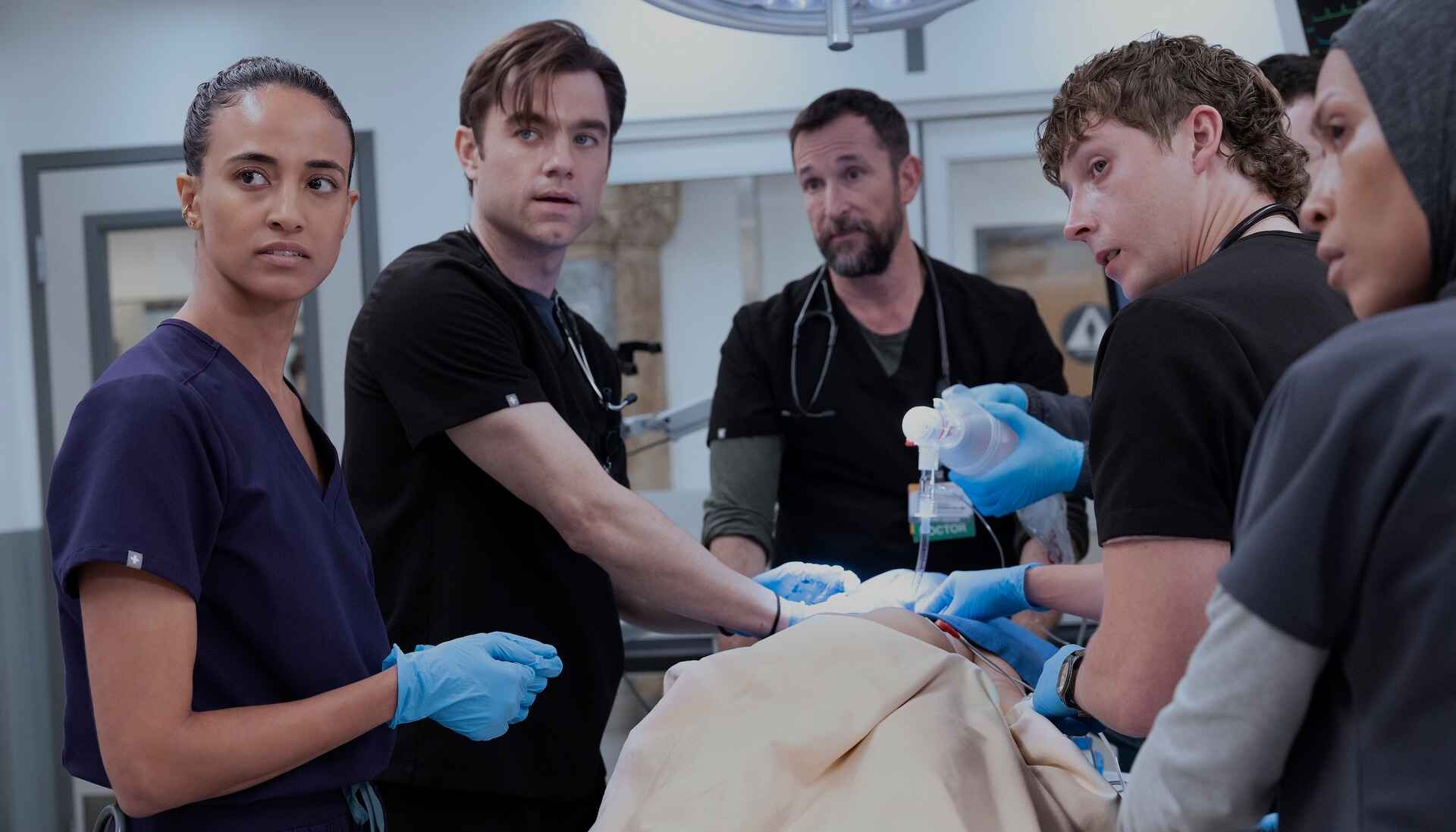
Image: HBO Max
You finish a long shift, sit in your car in the garage, and can't remember the name of the patient you spent an hour with. Not because you stopped caring, but because there was nothing left to care with. Then you watch The Pitt and see Dr. Robby doing the exact same thing. Healthcare burnout is chronic exhaustion, cynicism, and a sense of failure that builds after a long stretch of high-stress work, and HBO Max's medical drama puts it on screen with more accuracy than almost any show before it.
The show follows one fifteen-hour shift in the emergency room of a fictional Pittsburgh hospital, with Noah Wyle as Dr. Robby, the attending holding the department together. If you're here because you want to know whether The Pitt is actually accurate, the short answer is that doctors and nurses keep saying it is, and the burnout is the part it gets most right. At Anchor Therapy, we've worked with healthcare workers who say watching it felt less like entertainment and more like being recognized. This post walks through what the show gets right, what healthcare burnout actually looks like off screen, and how therapy helps you carry it differently.
Anchor Therapy is a counseling center in Hoboken, NJ with mental health therapists specialized in helping children, teens, adults, couples, and families with anxiety, depression, relationship issues, trauma, life transitions, and more. Anchor Therapy is accepting new clients and is now providing in-person sessions and teletherapy sessions to residents of New Jersey, New York, and Florida.
What Is The Pitt About?
The Pitt premiered in January 2025 on Max, now called HBO Max, and quickly became one of the platform's biggest dramas, winning the Emmy for Outstanding Drama Series in its first season. Each episode covers one real-time hour of the same shift, so the show never cuts away or skips forward. That structure means the audience feels the accumulation of fatigue right alongside the characters.
The series leans hard into the lasting effects of COVID-19 on healthcare workers. It also shows staffing shortages, underfunding, and the daily weight of fast, high-stakes decisions. Critics and healthcare workers alike have pointed out how rarely TV shows this side of medicine. Most medical dramas focus on dramatic surgeries and personal drama, while The Pitt spends just as much time on short-staffed shifts and patients who don't make it.
Why The Pitt Feels So Real to Healthcare Workers
Plenty of healthcare workers have said online that The Pitt is the first show that got their job right. That reaction says a lot about how invisible healthcare burnout usually is. Most workplace dramas treat stress as a subplot, while The Pitt treats it as the entire environment its characters are breathing.
In our view, that's exactly why the show works as a mental health story, not just a medical one. It doesn't resolve the exhaustion by the end of the episode. It shows characters snapping at each other, going numb, and pushing through symptoms that would be red flags in any other context. That's a truer picture of burnout than most shows offer, and it's part of why so many healthcare workers say they finally feel seen.
What Is Healthcare Burnout?
Healthcare burnout is a work-related stress syndrome marked by emotional exhaustion, cynicism toward patients, and a shrinking sense of accomplishment. It builds slowly from ongoing job stress, not from one bad day. Emergency medicine has one of the highest burnout rates of any specialty.
That's part of why a show set entirely in an ER hits close to home for so many healthcare workers.
Burnout is more than feeling tired after a long shift. Burnout changes how people treat their patients, their coworkers, and even themselves.
Signs of Healthcare Burnout The Pitt Gets Right
The show depicts a range of burnout symptoms without naming them clinically, which is part of what makes it feel authentic. Some of the most accurate moments track closely with real symptoms:
Emotional exhaustion that shows up as flatness or irritability rather than obvious sadness
Cynicism or detachment toward patients, especially repeat visitors or people whose conditions feel preventable
A shrinking sense of accomplishment, even after a shift full of technically successful outcomes
Physical depletion that doesn't resolve with a single night's sleep
Difficulty leaving work at work, with the shift replaying mentally long after clocking out
Watching these symptoms play out on screen can feel validating. Healthcare workers who've lived through the same thing may never have heard it called burnout before.

Is The Pitt Realistic About Healthcare Worker Burnout?
Yes, in the ways that matter clinically. The show has been praised by physicians and medical publications for its accuracy, and much of that accuracy comes from how it treats burnout as systemic rather than personal. The characters are burned out because the system keeps demanding more than any one person can sustainably give, not because they're weak.
Most media coverage misses this and frames burnout as a person failing to handle stress. The Pitt frames it as the normal result of understaffed, high-stakes work which matches how clinicians actually see it.
We've also written more specific tips for healthcare workers experiencing burnout for anyone who wants practical strategies beyond what's covered here.
How Common Is Burnout Among Healthcare Workers?
Burnout among healthcare workers is very common, and emergency medicine has the highest rate of any specialty. A national survey of US doctors put emergency medicine at 65.9 percent. That data comes from a review on the National Library of Medicine's NCBI Bookshelf, which also found more than half of US doctors reported burnout by 2014.
The picture isn't limited to physicians. A study of healthcare workers three months into the COVID-19 pandemic found that 51.8 percent experienced burnout at least once a week.
That same study found 24.3 percent showed symptoms consistent with Post-Traumatic Stress Disorder (PTSD). Numbers like these help explain why The Pitt's premise, one relentless shift with no real break, lands as realistic instead of exaggerated.
Why Emergency Medicine Has the Highest Burnout Rate
Emergency departments combine several burnout risk factors at once. Patients arrive without appointments or warning, decisions have to happen fast, and staff rarely get to see how a case resolves once a patient moves elsewhere in the hospital. There's little closure and even less control over the pace of the day.
Add chronic understaffing and the ongoing aftershocks of the pandemic, both shown often in the show, and it's easy to see why ER staff report burnout more than almost any other specialty. The job is built for constant demand with little time to recover in between.
The physical toll compounds the emotional one. ER shifts often run twelve hours or longer, and overnight or rotating schedules disrupt sleep for months at a time. Staff frequently skip meals or bathroom breaks just to keep up with patient flow. A body that's constantly under-rested and under-fed has less capacity to absorb everything else the job asks of it.
What The Pitt Gets Right About Compassion Fatigue and Secondary Trauma
Compassion fatigue is the emotional cost of caring for people in crisis, over and over. It often overlaps with secondary trauma which builds from watching other people's pain again and again. The Pitt shows both clearly. Its characters carry the weight of one patient into the next case, and the one after that.
This is a piece we see often in our own work with healthcare clients. Compassion fatigue usually looks like irritability, dark humor as a coping mechanism, or a growing wall between a provider and their own emotions rather than obvious sadness. The show captures that wall forming in real time.
How Healthcare Burnout Affects Life Outside Work
Burnout rarely stays contained to a shift. It tends to follow people home, showing up as short tempers with family, disrupted sleep, or a flat, checked-out feeling during time that's supposed to be restorative. Relationships can strain under the weight of a partner who's constantly depleted.
Some healthcare workers describe losing touch with why they chose the field in the first place. That disconnection from purpose is one of the harder parts of burnout to name because it can feel like something is wrong with the person rather than with the conditions they're working in.

What You Can Do If You're Experiencing Healthcare Burnout
Therapy is the most effective long-term path forward, but there are a few things that can help in the meantime, alongside the steps in our full burnout recovery plan:
Track your symptoms without minimizing them, including irritability, numbness, and physical exhaustion
Talk to a coworker who understands the specific pressures of your environment
Protect small pockets of true rest, even fifteen minutes, rather than waiting for a full day off to recover
Separate your worth from your productivity, especially on shifts that felt chaotic or incomplete
None of these steps fix the systemic issues driving healthcare burnout. They can help you stay afloat while you look for more sustainable support.
What The Pitt Shows About Moral Injury
Moral injury is the distress that builds when you're forced to act against your own values, or watch something happen that you can't stop, because of factors outside your control. It's closely tied to burnout but isn't quite the same thing. Burnout is about depletion. Moral injury is about the wound that comes from an impossible choice.
The Pitt depicts this constantly. Characters have to make quick calls about who gets attention first, knowing that someone will wait longer than they should. Those decisions are symptoms of a healthcare system that regularly asks providers to do more with less, then leaves them to carry the emotional weight alone. Calling them failures of character misses what's actually happening.
Compassion fatigue and moral injury both show up in our post on healing from medical trauma, for anyone who wants to go deeper into that side of things.
Naming moral injury on its own matters. It often needs different support than burnout does. Burnout responds well to rest, boundaries, and lighter workloads. Moral injury usually needs space to process the one moment that still weighs on you, not just a lighter schedule.
How to Support a Healthcare Worker in Your Life
Friends and family often want to help but aren't sure how. A few things tend to make a real difference:
Ask about their shift without immediately steering the conversation toward your own day
Avoid saying things like "at least you're saving lives," which can minimize what they're carrying
Notice when they've gone quiet or numb after a hard stretch of shifts, and check in directly
Encourage professional support without treating it as a last resort
Small, steady support adds up. Feeling like someone actually understands the weight of the job is often what makes it possible to keep carrying it.
How Therapy Helps With Healthcare Worker Burnout
Burnout-focused therapy helps you separate what's actually yours to carry from what belongs to a broken system. At Anchor Therapy, our burnout treatment gives healthcare workers space to process the emotional weight of the job. You won't just be told to practice more self-care. Self-care matters, but it doesn't fix a staffing shortage or an impossible caseload.
We've worked with nurses and physicians who came into therapy assuming they just needed to toughen up. Most of them were carrying years of unprocessed exhaustion and grief from patients they couldn't save. Therapy gave them a place to finally set that weight down instead of carrying it into the next shift.
Treatment often means talking through hard cases, one by one. It also means rebuilding boundaries around work, and dealing with compassion fatigue that's built up over time. For some clients, career counseling for healthcare professionals helps sort out whether the fix is better boundaries in the current job, or a bigger change altogether.
Is The Pitt Based on a True Story?
Not on one specific story, but the show draws heavily on real accounts from healthcare workers and consultants with emergency medicine backgrounds. The creators worked with physicians to shape the medical cases and the pacing of a real ER shift which is part of why so many healthcare workers find it accurate.
That grounding in real clinical experience is part of what separates The Pitt from a typical medical drama built mostly for shock value.
Is Healthcare Burnout the Same as Depression?
No, though the two can overlap and are sometimes hard to tell apart. Burnout is tied specifically to work and tends to ease when the work stressors change. Depression tends to affect every part of life, not just the job, and usually needs its own separate treatment plan.
A clinician can help sort out which one you're dealing with since the right diagnosis shapes what actually helps.
When Should You Reach Out for Support?
The right time to reach out is whenever exhaustion, cynicism, or numbness from work start affecting your relationships, your sleep, or your sense of who you are outside your job. Healthcare burnout is treatable. Getting support doesn't mean you're failing at your job.
At Anchor Therapy, we work with healthcare workers and other people in high-stress jobs, in-person in Hoboken, NJ, and virtually in New Jersey, New York, and Florida. That flicker of recognition while watching The Pitt is worth noticing, not brushing off.
Whenever you're ready to talk to someone, you can reach us through the intake form below. Our intake coordinator will get back to you with more information and introduce you to our team of therapists. Whatever shift you're coming off of, you don't have to process it solo.

Victoria Scala
is the Community Engagement Director, Office Manager, and Social Media Manager at Anchor Therapy in Hoboken, New Jersey. She is a graduate of the Honors College of Rutgers University-Newark and is currently studying Clinical Mental Health Counseling at the graduate level.
IF YOU’RE LOOKING FOR HELP FROM A PROFESSIONAL COUNSELOR TO ASSIST YOU IN MAKING POSITIVE CHANGES IN YOUR LIFE, CONTACT US
WORKING WITH US IS EASY
Fill out the contact form below.
Our intake coordinator will get back to you with more information on how we can help and to schedule an appointment. We will set you up with an experienced licensed therapist who specializes in what you're seeking help with and who understands your needs.
You’ll rest easy tonight knowing you made the first step to improve your life.
Having trouble with this form? Email us directly at info@anchortherapy.org with the information in the form.



Maybe you're the one who gets blamed no matter what actually happened, at home, at work, or even with friends. Something goes wrong, and somehow it lands on you. If that sounds familiar, there's a word for what's happening: scapegoat. A scapegoat is a person who's unfairly blamed for problems they didn't cause. Scapegoating shows up most in families, where it's often called being the family scapegoat.