
OCD Therapy in Hoboken, NJ
In-person OCD therapy in Hoboken, NJ, and video sessions across New Jersey, New York & Florida.
A locked door doesn't always feel locked until you've checked it five times. An intrusive thought won't let go, even though you know it doesn't make sense. If this sounds familiar, you're not alone, and OCD therapy can help.
If you've been searching for an OCD specialist near me, an OCD therapist near me, or therapy for OCD in Hoboken, you've found the right team. Obsessive-Compulsive Disorder, or OCD, is a mental health condition marked by unwanted, repeated thoughts, called obsessions, and the urges or rituals used to relieve them, called compulsions.
At Anchor Therapy, our licensed team holds LCSW, LSW, LPC, and LAC credentials, and our OCD therapists in Hoboken use Exposure and Response Prevention (ERP) Therapy and Cognitive Behavioral Therapy (CBT) to help you break that cycle.
Reach out by filling out the form at the bottom of this page to start OCD therapy with one of our Hoboken therapists.
Signs You Might Benefit From an OCD Specialist
Many people live with OCD symptoms for years before reaching out. If a few of these sound familiar, an OCD specialist can help:

What Is OCD?
OCD gets misunderstood as simply liking things neat or clean. The reality is more layered. OCD involves obsessions, unwanted thoughts or images that trigger intense anxiety, and compulsions, the behaviors or mental rituals you feel driven to perform to relieve that anxiety.
The relief compulsions bring is real, but it never lasts. Each time you complete a ritual, your brain collects a little more evidence that the ritual is what kept you safe, so the obsession comes back with more authority than it had before.
Without treatment, this cycle tends to grow. It can start with a five-minute check and slowly take over an hour of your morning. It can turn a quick errand into something you avoid altogether.
OCD Themes We Treat
OCD usually organizes itself around a theme. Common themes we see at Anchor Therapy include:
- 1Contamination fears, a fear of germs or illness that leads to excessive washing or avoidance
- 2Order and symmetry, where things feel deeply wrong unless arranged a certain way
- 3Relationship OCD (ROCD), constant doubt about whether your relationship, or your feelings for your partner, are “right”
- 4Harm and aggressive intrusive thoughts, unwanted images or urges about hurting yourself or someone you love, which cause real distress because they go against your values
- 5Moral or religious obsessions, sometimes called scrupulosity, excessive worry about whether you've sinned or acted immorally
- 6Health-related obsessions, where a physical sensation spirals into repeated symptom searches, self-checks, or doctor visits
- 7Purely mental OCD, sometimes called Pure O, where the compulsions are silent mental rituals instead of visible actions

What Causes OCD?
The exact cause of OCD isn't fully understood, but several factors tend to increase the odds a person will develop it or experience a flare-up. Family history plays a role. OCD tends to run in families, and researchers have linked it to differences in certain brain circuits involved in habit and fear response.
Life events matter too. A period of high stress, a major life transition like a move, a new job, or a new relationship, or a history of trauma can all trigger a first episode or worsen existing symptoms. Getting sick can play a role as well, since illness sometimes sets off a cycle of repeated worry about contamination or health.
None of this means OCD is anyone's fault. It's a treatable condition, not a character flaw, and understanding what feeds it is often the first step toward loosening its grip.
Many of the clients we see felt embarrassed about their symptoms before starting treatment, and that shame tends to ease once they realize how common and well understood OCD actually is.
Get startedOCD Therapy Hoboken Clients Trust: ERP and CBT
Whether you found us searching for therapy for OCD in Hoboken or an OCD specialist near me, our approach is the same. Our OCD counselors treat every case individually, and most of our work draws from two proven methods. Exposure and Response Prevention, or ERP, gradually exposes you to the situations that trigger your obsessions while helping you resist the urge to perform the compulsion that usually follows.
Every time you avoid a trigger or complete a compulsion, you teach your brain that the trigger really was dangerous and that the ritual is what kept you safe.
ERP interrupts that lesson. By facing the trigger and choosing not to complete the compulsion, your nervous system learns something new. The anxiety rises, then comes back down on its own, without a ritual required.
A peer-reviewed meta-analysis of nearly 40 clinical trials found that ERP produces a measurable reduction in OCD symptoms compared to placebo treatment, and the effect holds up across therapist-guided and self-guided formats. In our work with OCD at Anchor Therapy, the turning point is rarely one big exposure. It's the smaller, repeated practice of sitting with discomfort without performing the ritual, session after session, that builds lasting change.
If you've been comparing OCD treatment options near you, it's worth knowing that ERP is considered the frontline approach for most cases of OCD. It's the method our team leans on first.
Cognitive Behavioral Therapy, or CBT, works alongside ERP by helping you examine the distorted thoughts that fuel your obsessions. Your OCD therapist will help you notice when you're overestimating danger or responsibility, then practice responding differently. Many of our therapists layer ERP and CBT together, adjusting the mix as you make progress.

Who We Help
OCD shows up differently from person to person.
Our OCD therapists in Hoboken most often work with people managing:
- 1Contamination and health fears that shrink daily routines
- 2Relationship doubts that put strain on a partnership
- 3Intrusive thoughts about harm that create shame and secrecy
- 4Checking and reassurance seeking that eats into work or school
Many of the clients we see are also managing anxiety alongside OCD, and our anxiety counseling services address that overlap directly. For teens whose OCD shows up at school or at home, our teen counseling team tailors the same ERP and CBT approach to a younger client.
What an OCD Therapy Session Looks Like
Your first session focuses on understanding your specific triggers and how compulsions show up in your daily life, not on diving straight into exposure work. Your therapist will ask about your history, your current routines, and what you're hoping treatment will change.
From there, you and your therapist build a plan together, often starting with lower-stress exposures and working up to harder ones at a pace that feels manageable. You're never asked to do something you haven't agreed to first, and your therapist checks in with you throughout each exposure rather than leaving you to sit with it alone. What you share in session stays private, held to the same confidentiality standards you'd expect from any mental health provider.
Outside of the session, your therapist may ask you to practice specific exercises between visits. This practice is often what makes the difference between symptom relief that fades and change that sticks.
If that sounds like the kind of structure you've been looking for, you can start here. Tell us a little about what's going on and our intake coordinator will take it from there.
Where We Provide OCD Therapy in Hoboken and Beyond
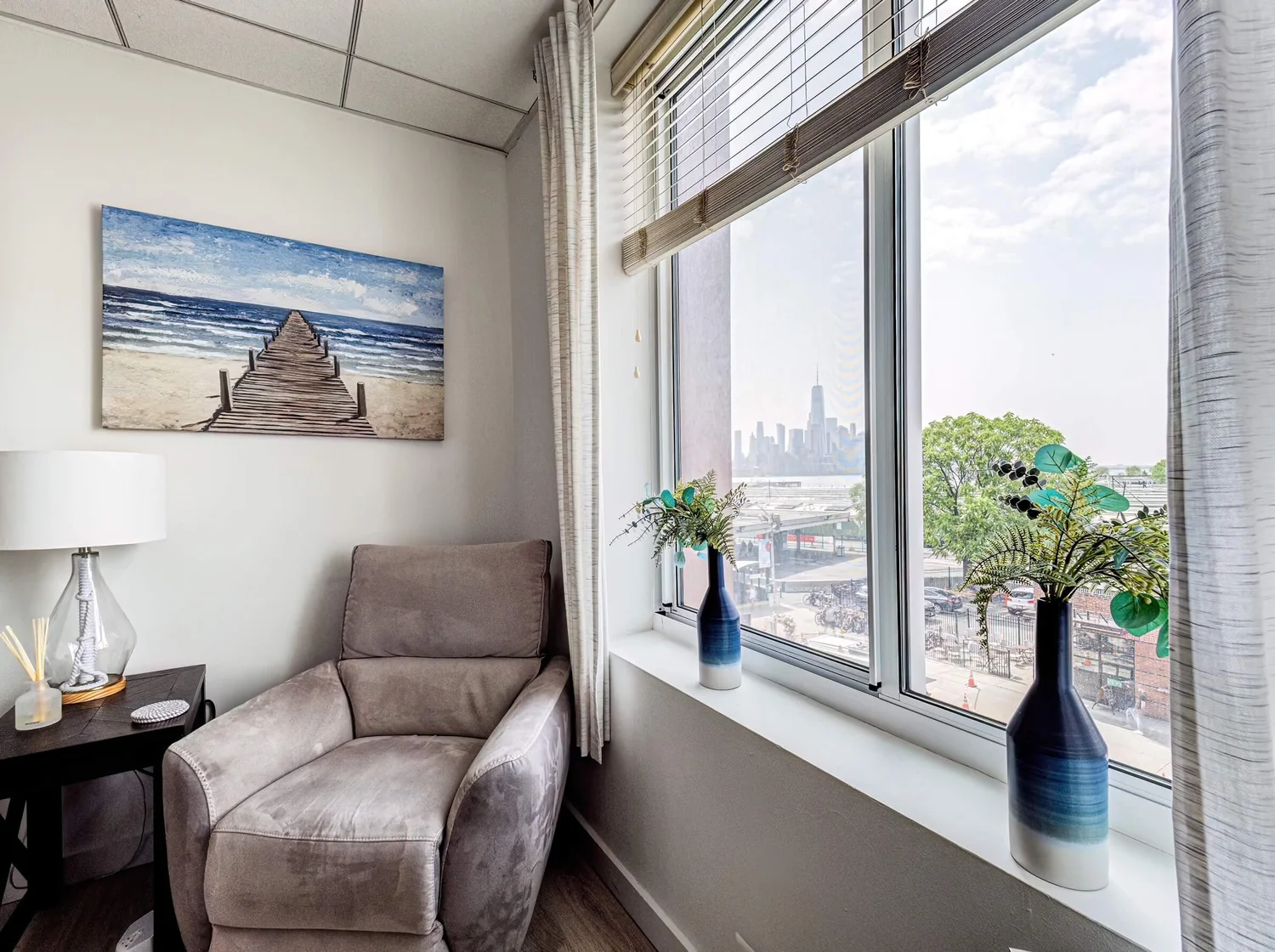
Our office is on River Street in Hoboken, a short walk from Hoboken Terminal. We see clients there in person for OCD therapy, and many of them come from Hoboken and nearby Hudson County towns like Jersey City, Weehawken, and Union City.
If you've been looking for an OCD therapist near you, or an OCD therapist in NJ who actually practices ERP rather than general talk therapy, our Hoboken office is a realistic option for anyone in Hudson County. We also work with clients through secure video sessions across New Jersey, New York, and Florida.
Several of our therapists have specialized training in ERP, and Anchor Therapy has been providing therapy for OCD in Hoboken for many years. Consistency is a big part of why in-person OCD therapy in Hoboken works so well for local clients, because ERP builds on itself week to week and the gains fade when sessions get spread too far apart. OCD is one of the areas our team gets asked about most often by new clients in Hudson County and across the state.
Meet Our OCD Therapists
Our OCD therapists are licensed professionals with specialized training in ERP and CBT. You can read about each therapist on our Meet Our Team page. Our intake coordinator will match you with the therapist whose training and style fit your needs, based on your specific OCD themes and what you're looking to get out of treatment.
How to Get Started with OCD Therapy Near You
Fill out the form
Use the form at the bottom of this page and tell us a little about what you're experiencing.
We'll match you
Our intake coordinator reaches out to match you with an OCD therapist whose training fits your needs, and to find a session time that works for you.
Meet and set goals
You meet with your OCD therapist for your first session, set goals together, and build a plan you feel good about. From there, you'll meet at a pace that fits your progress.
Frequently Asked Questions About OCD Therapy
Do you take insurance?
We're out of network with insurance. Many clients use the superbills we provide to seek out-of-network reimbursement from their insurer. Reach out by filling out the form at the bottom of this page, and we'll walk you through the cost and what reimbursement could look like for you, then match you with the right therapist.
Do you offer virtual OCD therapy?
Yes. We offer secure video sessions for OCD therapy across New Jersey, New York, and Florida. That's a good fit for busy schedules, or for anyone who lives outside Hoboken and still wants a therapist trained in ERP. In-person sessions are also open at our Hoboken office.
Do you offer in-person OCD therapy in Hoboken?
Yes. Our office is at 80 River Street in Hoboken, and we see clients there in person for OCD therapy, including ERP sessions. If in-person doesn't work for your schedule, we also offer secure video sessions across New Jersey, New York, and Florida.
How long does OCD therapy take?
It depends on your symptoms and goals. Some clients see meaningful change within a few months of consistent ERP work, especially when a specific theme like checking or contamination is the main focus. Others, especially with longstanding or more complex OCD involving several themes at once, benefit from a longer course of treatment. Your therapist will check in often about progress and pace, and adjust the plan as needed.
What's the difference between OCD and generalized anxiety?
Generalized anxiety involves broad worry about everyday things like work, health, or money. OCD is more specific. It centers on particular obsessions paired with compulsions meant to neutralize them. Many people have both, and an OCD specialist can help sort out what's driving what.
Do you treat teens with OCD?
Yes. Our team works with both adults and teens who have OCD, adjusting our approach to fit where each client is developmentally. Reach out through the form and let us know the age of yourself or your child who is seeking treatment.
What if my OCD doesn't involve visible compulsions?
That's common, and it's sometimes called Pure O. Your compulsions might be mental, like replaying a scenario, silently praying, or mentally reviewing to seek certainty. ERP and CBT still apply. Your therapist will simply target the mental rituals instead of physical ones.
Start OCD Therapy in Hoboken
OCD can make even small decisions feel high stakes, but you don't have to manage it on your own. With the right support, the anxiety that drives obsessions and compulsions loses its grip, and you get your time and attention back.
If you've been searching for an OCD specialist near you, this is the easiest place to start. Fill out the form at the bottom of this page and our intake coordinator will match you with the right therapist for what you're working on. We provide therapy for OCD in Hoboken in person, and virtually across New Jersey, New York, and Florida.










You notice yourself blinking. Now you can't stop noticing yourself blinking. An hour later you're still aware of every single blink, every swallow, the way your tongue sits in your mouth. You're not sick, nothing is actually wrong with your body, but you can't get your attention to let go of it either.
Somatic OCD is a subtype of Obsessive-Compulsive Disorder (OCD) where you become fixated on a normal, automatic body process, like breathing, blinking, or swallowing, and can't stop monitoring it once it's caught your attention. The sensation itself isn't dangerous, what's distressing is the awareness, the sense that you're now trapped noticing something you used to do without thinking at all. If you've ever gotten stuck on your own breathing or heartbeat for hours and wondered if something was seriously wrong with you, you're not broken, and you're not alone. This post covers what somatic OCD actually is, how it's connected to sensorimotor and hyperawareness OCD, and what actually helps you stop feeding the loop.