
Antonio Rudo, LPC
Psychotherapist
Works withTeens (15+ years old), Adults, Couples, Families, and LGBTQIA+
SpecialtiesAnxiety, Depression, Relationship Issues, Trauma, Addiction, Life Transitions, Self-esteem, Identity, and more
Read Antonio's bio →
A short walk from the PATH station, open seven days a week for kids, teens, adults, couples, and families.




If you're searching for in person therapy near me, you want a real office you can walk into. Our Hoboken counseling office sits at 80 River Street, right across from the PATH station, and it's where our therapists see clients face to face every day of the week.
Our therapists hold LCSW, LPC, LSW, and LAC licenses, and many have advanced training in approaches like CBT, EMDR, and the Gottman Method. Whoever you're matched with, you're working with a fully licensed therapist. Anchor Therapy has been voted Best Therapist in Hoboken four times.
Whether you've never sat across from a therapist before or you've done this for years, our Hoboken office is built to make that first step easier. Reach out by filling out the form at the bottom of this page to set up your first in-person therapy session.
In-person therapy is simply psychotherapy delivered face to face, in the same room as your therapist, rather than over video or phone. You meet one on one in a private room, usually for about 45 to 60 minutes a week, and the session starts the moment you sit down together.
Many of the clients we see in Hoboken tell us that walking into a private room changes the pace of a session in a way a screen doesn't. Clients often tell us the office itself has something to do with it, that they feel calmer the moment they step inside and settle into a private, safe space where they can focus on themselves. As a client, it's easier to stay present with someone, and to read a pause or a shift in posture, when you're both actually in the room.
Some clients also use the trip itself as part of the work. The walk to our office is a few minutes to settle in before your session, and the walk home is a few minutes to sit with whatever came up, before you're back to the rest of your day.
Your first session looks less like an interview and more like a conversation. Your therapist will ask what brought you in, what's been hard lately, and what you're hoping changes. There's no script to follow and no pressure to have it all figured out before you walk in the door.


Our therapists draw on a handful of proven approaches and match the method to the person, not the other way around. For anxiety, panic, and repetitive negative thought patterns, that often means CBT, which gives you concrete tools for the moment a spiral starts. If you're looking for a trauma therapist, our team includes therapists trained in EMDR, which uses bilateral stimulation like guided eye movements to help the brain reprocess a memory. We offer EMDR in the office and over video, and some clients tell us they'd rather do that work in the room with their therapist.
For couples, many of our therapists use the Gottman Method, which relies heavily on reading both partners' body language in real time, something that's simply easier to do in the same room. In our work with couples at our Hoboken office, we've noticed that sitting knee to knee with a partner, instead of stacked together on video, changes how honest people are willing to be.
Whatever brought you in, your therapist will walk you through which approach fits and why, and adjust as you go. Following a method perfectly matters less than making real progress on what brought you in.
Our office is easy to reach no matter how you get around Hoboken. We're directly across from the Hoboken PATH station, so if you're coming from Manhattan it's a quick ride and a short walk. Hoboken Terminal sits right there too, which means you can get to us by:
Driving in is simple too. Hoboken has paid street parking, and if you'd rather not circle the block, the LM Parking Garage at 111 River Street is about a two-minute walk from our door.
However you get here, you won't need to build in much extra time. The walk from the PATH station to our door takes about three minutes, so you can leave your apartment or hop off the train with just enough buffer to arrive relaxed instead of rushed.
Once you're in the building, here's how to find us. Come through the entrance and walk down the hall to the elevator, then take it to the third floor. Turn right out of the elevator, follow the hallway to the end, and take the short staircase or the ramp up to the second landing. Our suite is on the right, and you'll see an anchor welcome mat and our logo on the door.

Our waiting room is spacious and comfortable, not a cramped hallway with a folding chair. If you'd like a partner, parent, or loved one to wait during your session, they're welcome to sit in our waiting area.
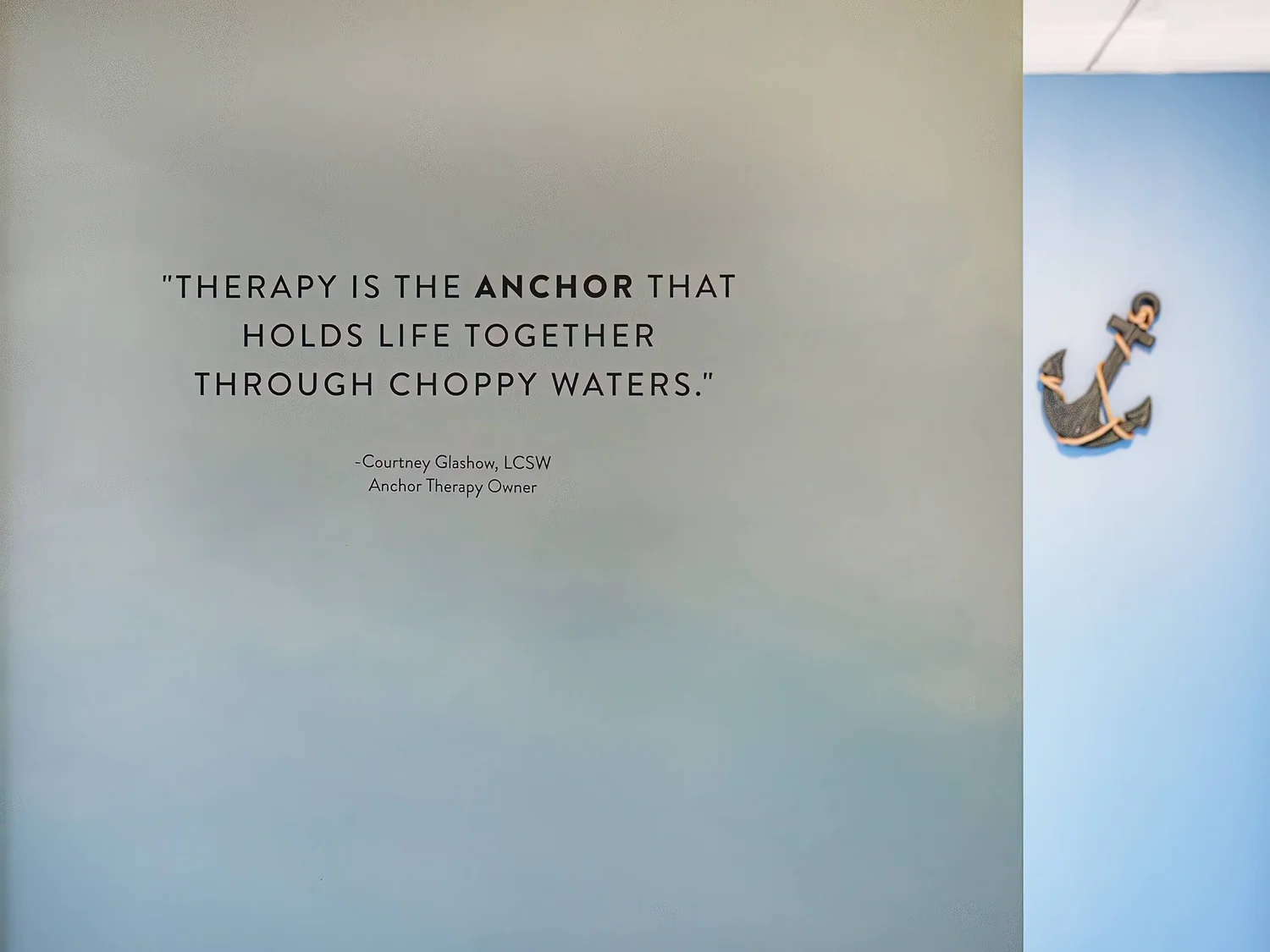
The whole suite is decorated in calm blue tones with nautical touches, which is where our name comes from. On the waiting room wall you'll find a quote from our owner and psychotherapist, Courtney Glashow, LCSW: “Therapy is the anchor that holds life together through choppy waters.”
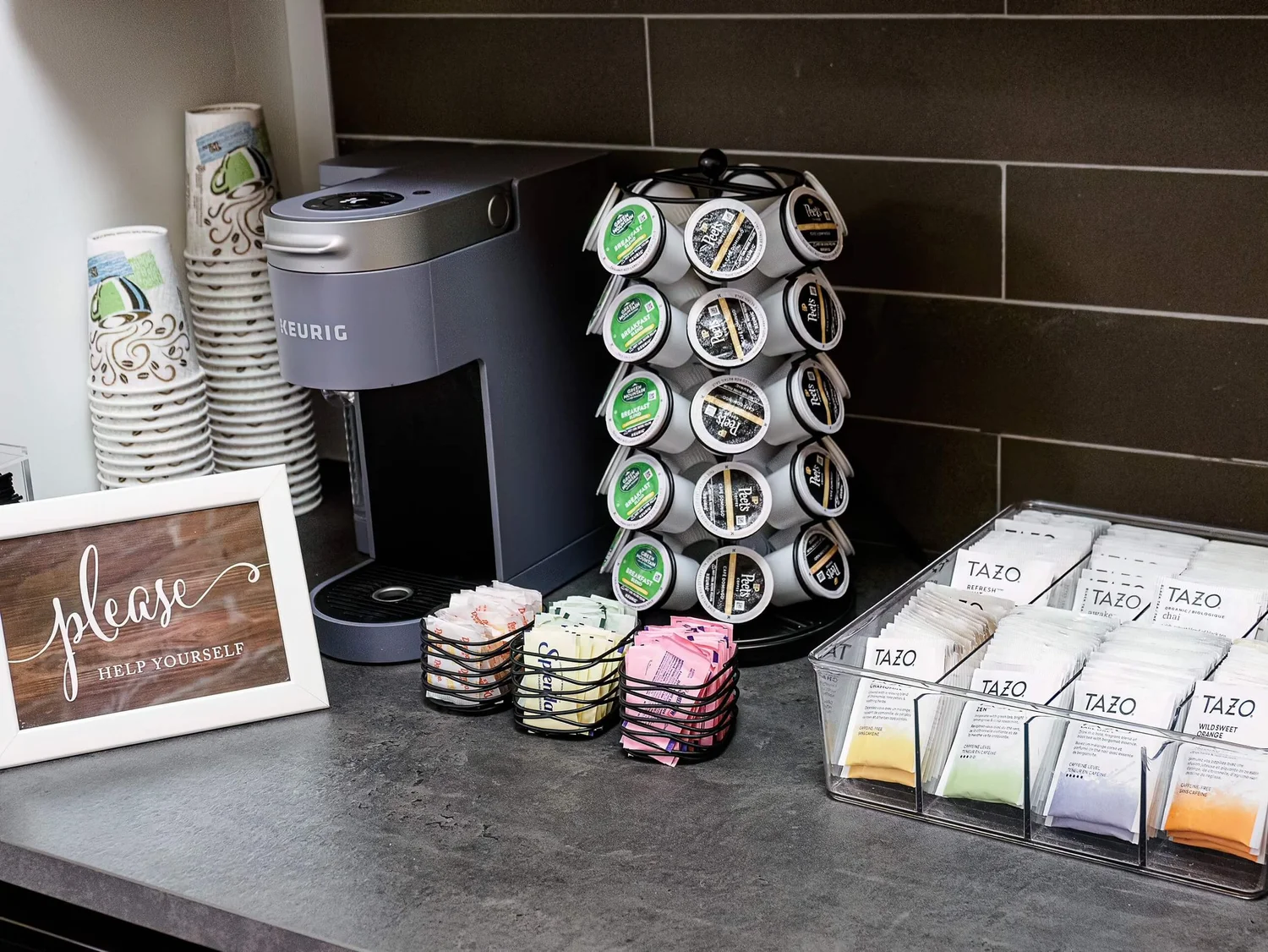
We also keep a small kitchen space stocked for clients. Help yourself to complimentary tea, water, coffee, hot chocolate, or a piece of chocolate before or after your session. At Anchor Therapy, these are the small things that our clients notice and appreciate. The office feels less like a waiting room and more like somewhere you’d actually want to sit for a few minutes.
Once you're back with your therapist, you're in a private room built for conversation. That privacy is part of what makes it easier to say things out loud that are hard to say anywhere else.
That matters most when home isn't private. If you share an apartment, live with family, or work from your kitchen table, this room gives you an hour that belongs only to the session.
Our Hoboken office is open for in-person sessions seven days a week, so you're not stuck choosing between therapy and your work schedule. Our intake coordinator can help you find a day and time that actually fits your week.
We offer same-week appointments for new clients. To get started, fill out the form at the bottom of this page.
Book your first in-person session with one of our Hoboken therapists by filling out the form at the bottom of this page.
Get startedOur Hoboken office welcomes clients at every age and stage.

Help with anxiety, big feelings, behavior challenges, and the worries younger kids can't always put into words.
Learn more →
Somewhere to talk openly about school, friendships, identity, and the pressure that keeps piling up.
Learn more →
Support for anxiety, stress, relationships, and the big transitions that come with adult life.
Learn more →
Reconnect, rebuild trust, and learn to talk so you both finally feel heard.
Learn more →
Find your way through tension and change together, and build a calmer, kinder family life.
Learn more →
Affirming care where you're seen and supported as your full self.
Learn more →Our Hoboken office is staffed by a full team of licensed therapists, not a single provider seeing everyone. That means we can match you with someone whose training and style actually fit what you're working on, rather than whoever happens to have an opening.
Between our therapists, the team covers a wide range of specialties, from child and family work to couples counseling, trauma, and anxiety. If your first match doesn't feel right, our intake coordinator can help you find someone else who's a better fit.
Psychotherapist
Works withTeens (15+ years old), Adults, Couples, Families, and LGBTQIA+
SpecialtiesAnxiety, Depression, Relationship Issues, Trauma, Addiction, Life Transitions, Self-esteem, Identity, and more
Read Antonio's bio →
Psychotherapist · Clinical Supervisor
Works withChildren (all ages), Teens, Adults, Families, and LGBTQIA+
SpecialtiesADHD, Behavioral Issues, Anxiety, Depression, Trauma, Parenting, Women's Issues, Family Conflict, and more
Read Carmen's bio →
Psychotherapist · Owner
Works withChildren (10+ years old), Teens, Adults, Parents, and LGBTQIA+
SpecialtiesAnxiety, Depression, Life Transitions, Relationship Issues, Parenting, Postpartum & Fertility, Self-esteem, and more
Read Courtney's bio →
Psychotherapist · Senior Clinical Supervisor
Works withTeens (15+ years old), Adults, Couples, Families, and LGBTQIA+
SpecialtiesRelationship Issues, Anxiety, Depression, Trauma, Substance Abuse & Addiction, Grief, Life Transitions, Postpartum, and more
Read Elena's bio →
Psychotherapist
Works withChildren (5+ years old), Teens, Adults, and LGBTQIA+
SpecialtiesAnxiety, Depression, Self-esteem, School Issues, Life Transitions, Relationship Issues, Identity, Parenting, Grief, Trauma, and more
Read Kim's bio →
Psychotherapist
Works withChildren (5+ years old), Teens, Adults, Couples, Families, and LGBTQIA+
SpecialtiesRelationship Issues, Trauma, Anxiety, Depression, Family Conflict, Parenting, Life Transitions, Postpartum, and more
Read Laura's bio →
Psychotherapist
Works withTeens (18+ Years Old), Adults, Couples, Families, and LGBTQIA+
SpecialtiesTrauma, Anxiety, Substance Abuse, Relationship Issues, Depression, Family Conflict, Work Stress, Grief, and more
Read Maria's bio →
Psychotherapist · Clinical Director
Works withTeens (18+ years old), Adults, Parents, and LGBTQIA+
SpecialtiesSubstance Abuse & Addiction, Anxiety, Depression, OCD, Trauma, Grief, Postpartum & Fertility, and more
Read Michele's bio →
Psychotherapist · Office Manager · Social Media Manager · Community Engagement Director
Works withTeens (15+ years old), Adults, Couples, Families, and LGBTQIA+
SpecialtiesRelationship Issues, Anxiety, Breakup, Self-esteem, Life Transitions, Depression, Grief, Trauma, Parenting, and more
Read Victoria's bio →Video therapy works well for a lot of people, and plenty of our clients choose it on purpose. Presence just works differently from one person to the next. Some clients focus better without a screen between them and their therapist, or simply want a dedicated space that isn't also their kitchen table.
Research backs up part of what we see in the office. A review published in the American Psychiatric Association's journal Focus found that while clients tend to rate their sense of connection similarly whether they're on video or in person, therapists themselves often rate that connection as somewhat stronger in face-to-face sessions. Both formats build a real working relationship. That finding is simply one reason some clients prefer to come into the office.
If a video session across New Jersey, New York, or Florida fits your life better, that's a good option too, and you'd be working with the same team either way. Neither format is the right answer for everyone, and part of our intake conversation is figuring out which one fits how you actually work best, and which one fits your lifestyle and schedule.
If you've been searching for in-person therapy near me, our office is at 80 River Street, Suite 306, Hoboken, NJ 07030, directly across from the PATH station. You can reach us at (201) 565-2275.
Many of the clients we see in person are commuting in from nearby. We regularly see people from Jersey City, Weehawken, and Union City, along with New Yorkers who hop on the PATH from Manhattan for their session.
Downtown Hoboken is a compact, walkable area, so once you're off the train or out of your car, you're rarely more than a few minutes from our door. We also see clients virtually across New Jersey, New York, and Florida for those who aren't close enough to come into the office.
Do you take insurance?
We're out of network with insurance. Many clients use the superbills we provide to seek out-of-network reimbursement from their insurer. Reach out by filling out the form at the bottom of this page, and we'll walk you through the cost and what reimbursement could look like for you, then match you with the right therapist.
Is parking available near your office?
Yes. There's street parking nearby, plus a few parking garages within a short walk if street spots are full.
What should I expect at my first in-person session?
Plan to arrive a few minutes early to settle into our waiting room and grab a coffee or tea if you'd like one. Your therapist will meet you there and walk you back to a private room where you'll spend the session getting to know each other and talking through what brought you in. There's no paperwork to fill out on the spot since intake is handled beforehand.
Can a family member or partner wait during my session?
Yes. Our waiting room is spacious and comfortable, and a parent, partner, or loved one is welcome to wait there for the length of your session. For clients 13 and under, a parent or caretaker needs to supervise them in the waiting room, and we recommend staying through the session in case you're needed. Partners of adult clients are welcome to wait too.
Do you offer virtual sessions too?
Yes, alongside our in-person sessions in Hoboken, we offer video sessions for clients across New Jersey, New York, and Florida.
How long does in-person therapy usually take?
It depends on what brought you in. Some clients come for a short, focused stretch to work through a specific issue, like a recent breakup or a work transition, while others stay longer to work through something bigger, like a trauma history or a longstanding pattern. Your therapist will check in with you regularly about progress and pacing, so it never feels open-ended without a plan.
What if I've never been to therapy before?
That's common, and our therapists are used to working with people who are brand new to it. You don't need to know what to say or how therapy is supposed to work. Your first session is really just a conversation about what's going on and what you're hoping changes.
Use the form at the bottom of this page and let us know you're looking for in-person sessions at our Hoboken office.
Our intake coordinator reaches out to match you with a therapist and find a session time that works for your schedule.
You'll meet your therapist in person at 80 River Street and take it from there, one session at a time.
Our Hoboken office is a short walk from the PATH station and open seven days a week for in-person therapy. Fill out the form at the bottom of this page to get started, or visit our home page to learn more about Anchor Therapy. You can also read about our team of therapists on our Meet Our Team page before you reach out.
Maybe you're the one who gets blamed no matter what actually happened, at home, at work, or even with friends. Something goes wrong, and somehow it lands on you. If that sounds familiar, there's a word for what's happening: scapegoat. A scapegoat is a person who's unfairly blamed for problems they didn't cause. Scapegoating shows up most in families, where it's often called being the family scapegoat.
Love bombing can leave you doubting everything you felt. Here's how to recover from love bombing, why it hits so hard, and the steps that help you heal and trust yourself again.
You're walking on eggshells in your own home. Conversations that should be simple turn into something you have to brace yourself for, and the moment you push back on anything, the script flips and somehow you're the bad one. You've started Googling words like "narcissist" and "manipulation" at 11pm because you don't know what to call what's happening, but you know something is wrong. You searched for how to deal with a narcissist, and you landed here. This post walks through what actually counts as narcissistic behavior versus everyday self-centeredness, what to watch for in your own relationship, and 8 specific strategies our therapists at Anchor Therapy use with clients who can't, or aren't ready to, leave the relationship.
The first step to determine your dynamic with someone who you think is a narcissist is to know the difference between someone with narcissistic tendencies and someone with Narcissistic Personality Disorder.
Dr. Orna Guralnik, is a New York City-based Clinical Psychologist and Psychoanalyst, who rose to fame due to her hit Showtime television show, Couples Therapy. Couples Therapy is a documentary series that follows couples as they try to navigate their troubles and concerns. This unscripted series features real couples from the greater New York City area.
As viewers work through the show’s three seasons, they are taught to view the therapeutic process through a lens of compassion and empathy instead of hastiness. Episode by episode, viewers are immersed into the real world of couples counseling, viewing the progress and occasional backsliding of couples.
When you are in a healthy relationship, it naturally functions well. Of course, like any couple, you may have disagreements from time-to-time or there may be some hard times, but you band together no matter what. You are able to make major life decisions together, discuss problems once they occur, and genuinely enjoy spending time with one another.
On the other hand, you have toxic relationships. In a toxic relationship, the ‘norm’ is feeling drained and unhappy after spending time with your partner. This should be a major red flag that some things need to change.
You may still love your partner, but the relationship does not seem enjoyable. Maybe minor issues turn into full-blown arguments or you always seem to provoke one another. It may even get so severe that you dread spending time with your partner instead of getting excited to see them, like you were in the past.
Continue reading this blog to see if your relationship is toxic, and some guidance on how to navigate a toxic relationship.
Disney has a way of exploring heavier life topics that can help children and the 2021 film Encanto is no exception. Movies like Inside Out and Soul also assist children in exploring heavier aspects of life, such as emotions, trauma, consciousness, and even death. Encanto joins the long list of children’s movies that have a deeper message.
Disney’s Encanto offers a multigenerational story about a grandmother and her family who have been endowed with magical gifts. The Madrigal family lives in a hidden village in Colombia. While each family member does their best to live up to their reputation and help others in the community, the facade slowly begins to crumble figuratively and literally in the house that all three generations share.
Not only do people love this movie because of its catchy soundtrack, including the famous song “We don’t talk about Bruno”, but people also love it because of its exploration of generational trauma.
Do you have a hard time going with the flow? Do you have to follow a schedule or routine at all times? Do you try to control other people in your life? If you are dealing with control issues, it is likely that you feel like you must exert power over your life, relationships, and general environment. In some cases, this exertion of power may extend to the life of other people.
Control can simply be defined as exerting influence or power over the environment, actions, and behaviors of yourself or another person. There are many reasons why you may feel like you need to be in control, such as insecurities or fear of the unpredictable. At times, your need for control may become overwhelming and tiring, causing chaos in your career, relationships, and your overall quality of life.
When you think of a child, you probably imagine a young person who is resilient and fast-moving. These traits may cause you to believe that situations do not leave a lasting impact on children’s emotional health; however, that is not the case. If left unsolved, your emotions that came from a traumatic experience as a child can live in your subconscious mind. This will continue to affect you until you detect, process, and solve it. In order to heal childhood trauma as an adult, you have to learn how to process painful emotions.
A healthy way to respond to childhood trauma occurs right after the trauma has taken place. When the trauma occurs, you recognize that it is an offense to yourself. Afterward, you would feel your emotions and acknowledge the fact that the offense does not dictate anything about you personally. In other words, you do not make a negative meaning out of what occurred. Generally, it is rare for people to react in this manner.
This process is not automatic. Certain emotions, like rage and unhappiness, are difficult to express. On top of that, some cultures may view this outpouring of emotions to be socially unacceptable. Therefore, this causes many people to suppress their emotions. For a kid, this process is even more burdensome. For instance, someone may comment on a child’s weight or a part of their body which can cause a long-lasting inner dialogue to occur in the kid’s head, creating body dysmorphia. While this can happen to adults as well, it may be easier for an adult to push aside outside commentary in comparison to a child.
A lot of our clients find themselves giving away too much of themselves to others to a point that they feel worn out. Especially in this time during the holidays, people feel they need to give everything they can to others. Whether that is lending an ear to friends in need, giving gifts, or going above and beyond for others. If you find yourself doing to this to the point of exhaustion then you may be a people-pleaser. This usually means that you are taking care of others around you before you take care of yourself. Our clients who present as people-pleasers usually find themselves feeling anxious, drained, and overwhelmed.





You hit every deadline this week. You made it to Saturday’s soccer game, answered the late emails, and nobody at work would guess how many nights end with a bottle of wine you meant to stop halfway through. From the outside, life looks fine. So when the thought “Do I drink too much?” shows up, it’s easy to push it aside because you’re handling everything.
If you’ve typed “what is a high functioning alcoholic” into a search bar at 1 a.m., that question deserves a clear answer. A high functioning alcoholic is someone who meets the criteria for alcohol use disorder while still keeping up with work, family, and daily life. That’s why the drinking can stay hidden from the people around you, and often from yourself. Below, we’ll walk through the signs, why this pattern is so easy to miss, what tends to happen over time, and how therapy helps you or someone you love.